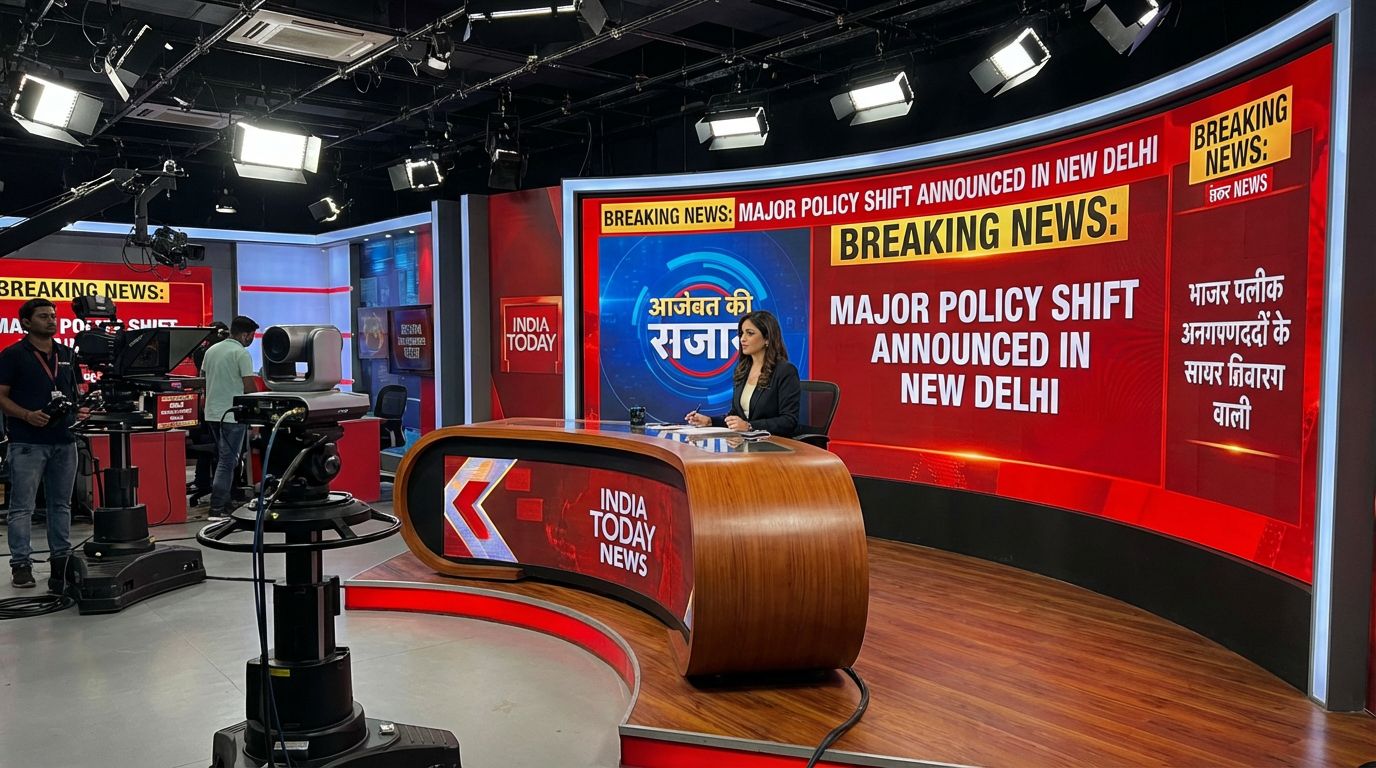
A national news channel's Delhi studio was refreshing its on-air look. The non-negotiable: LED backdrops that hold up under broadcast cameras — no moiré patterns, no scan lines, no colour shift between the wall on set and the wall on air.
The Challenge
Broadcast is the harshest test an LED wall faces. Studio cameras expose refresh artefacts invisible to the eye — moiré banding and scan lines that make footage unusable. The walls also had to hold consistent colour across long live bulletins under studio lighting.
The Solution
P1.5 fine-pitch LED walls with a camera-optimised 3840Hz refresh rate — four times the standard — plus on-site colour calibration matched to the channel's camera chain and lighting grid. Panels were profiled with the actual studio cameras before sign-off.
The Result
Zero moiré on air. The backdrop walls now carry live graphics, remote feeds and full-wall branding across every bulletin, and the studio look has become part of the channel's on-air identity.
✅ Free site visit across Delhi NCR — we measure, recommend the right spec, and quote on the spot. Get a free quote or WhatsApp +91 8368 283 916.
Project Specifications
| Parameter | Specification | Detail |
|---|---|---|
| Pixel pitch | P1.5 fine pitch | Broadcast-grade close viewing |
| Refresh rate | 3840Hz | Camera-optimised, 4× standard |
| Artefacts | Zero moiré | Verified with studio camera chain |
| Scope | Full studio refresh | Multiple backdrop walls |
Explore Further
Related Resources
Hotel Lobby Wall — Aerocity
Read case study →
Concert Tour LED Stage
Read case study →
Curved Atrium — Noida
Read case study →
Command Centre — Gurugram
Read case study →
Highway Billboard — Mumbai
Read case study →
All Case Studies
Learn more →
Broadcast LED
Learn more →
Fine Pitch Delhi
Learn more →
Indoor Video Walls
Learn more →
Get a Quote
Learn more →
Frequently Asked Questions
Minimum 3840Hz for professional broadcast — standard 1920Hz panels show moiré and banding under studio cameras. Refresh rate is the single most important spec for on-camera LED.
Moiré is interference between the camera sensor's scan and the LED refresh cycle. High refresh rates (3840Hz+) combined with correct shutter settings eliminate it — we profile panels with your actual cameras before handover.
P1.2–P1.9 depending on camera distance. This project used P1.5, which holds sharp in close-up shots while staying cost-efficient across large backdrop areas.